Services · Low-code interoperability

Low-code interoperability and migration.

Automated, model-driven migration maps your application to a platform-independent metamodel and generates target-platform artefacts — no manual rewriting required.
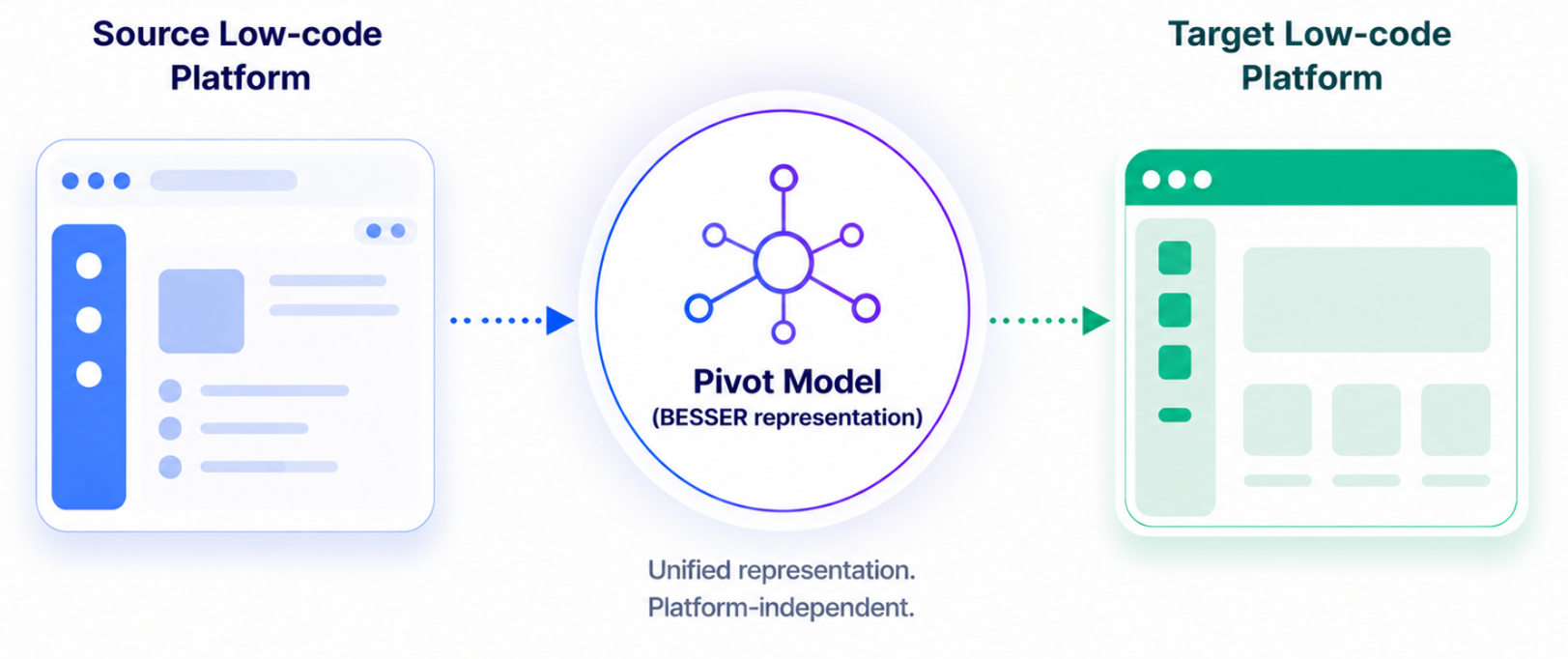
BESSER · Low-code interoperability pipeline
BESSER low-code interoperability pipeline — platform-independent migration
Why BESSER

Your apps, across low-code platforms.

Move your app to a new platform without touching a line of its logic — the pipeline handles extraction, transformation, and generation end to end.

Platform independent

Lift your app into a neutral metamodel that is not tied to any single vendor or tool.

Automated transformation

End-to-end pipeline from export to generated artefacts — no hand-editing required.

Reliable results

Deterministic generators produce the same output from the same model, every time.

Repeatable & extensible

Re-run any phase. Add new target platforms by extending the generator templates.

Capabilities

A low-code pipeline for low-code interoperability gives you all of this.

Two-phase migration

First, the data model (entities, relationships, constraints) is transformed into the target data model for the destination low-code platform. Then, the UI layer (pages, widgets, navigation) is generated.

  • Target data model generated with full constraints and foreign keys
  • GUI migration produces pages, components, and data bindings
  • Phases are re-runnable and inspectable

Platform-independent pivot model

Source apps are lifted into a unified B-UML (BESSER representation) metamodel before any target artefacts are generated — one transformation in, one out, for every platform.

  • Structural layer: entities, attributes, associations, enumerations
  • GUI layer: pages, containers, widgets, navigation, data bindings
  • One transformation per platform, in or out

Vision-based GUI extraction

Our Image-to-Model (I2M) pipeline lets you capture screenshots of each application page in the source platform and feed them to a vision-capable LLM — no manual reverse-engineering required.

  • Works on any platform you can screenshot, not just ones with export APIs
  • Vision LLM reconstructs page hierarchy, widgets, and bindings
  • Output is identical B-UML — feeds the same downstream generators

Deterministic code generation

Generation is fully deterministic: the same model produces the same output. Templates generate both the target data model and target UI artefacts, ready for deployment.

  • Target data model with inheritance, constraints, and relationships
  • Target UI pages and components with live data bindings
  • Jinja templates — readable, auditable, and extensible

Benchmarks & evaluation

We provide an open benchmark for cross-platform low-code migration based on real-world applications. Structural transformation achieves high coverage, including support for inheritance and enumerations, while GUI migration delivers consistently high accuracy across all evaluated apps.

  • High structural coverage, including inheritance and enumerations
  • Consistently high GUI migration accuracy across benchmark apps
  • Open benchmark with reproducible evaluation
View on GitHub